
A Future Nostalgia
We often long for what once was. But what will we one day long for that also used to be. I wonder what future nostalgia we are already creating without noticing.

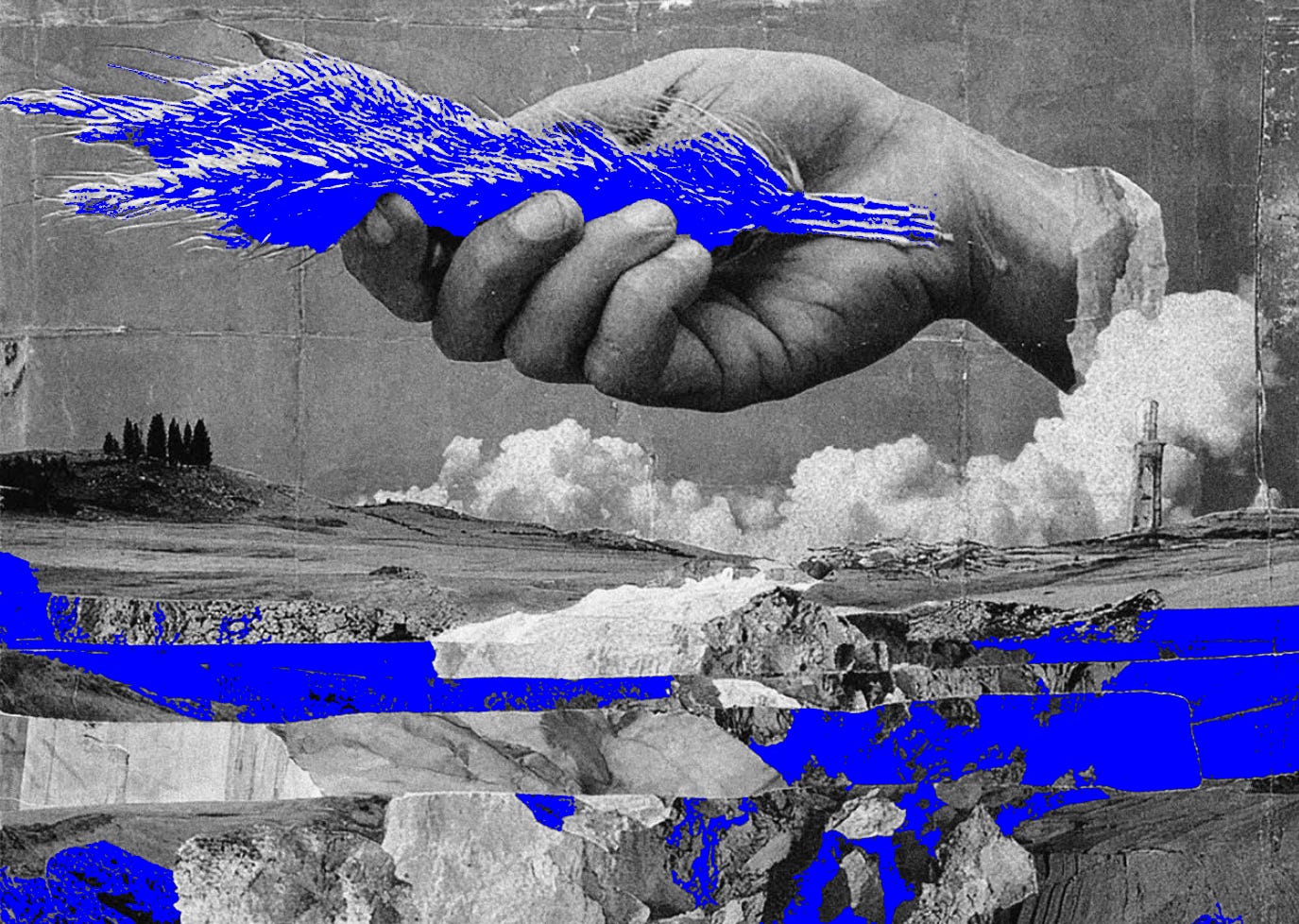
I’ll tell you a story. Whether it’s true or not is for you to decide. It takes place not far from where you are. Perhaps closer than you think.
I was walking on the outskirts of the wholescape clearing on a dry day. The acidic rains had finally paused, no longer eating away at the sandy path. The air stung my eyes and tasted metallic, sharp on the tongue. A faint smell of something burnt lingered. Blinking, I noticed something standing alone in the sand, catching the light.
It was a straw of grain. A single fragile stalk, a relic of another age. I bent closer, reached out, and held the thin stalk between my fingers. Its ear swayed faintly as I rocked it back and forth. Then, without warning, the ear came loose. I stood holding it in my hand, the straw beheaded.
At that very moment, the ground stirred. The sand and gravel around the broken stalk began to tremble, and then it gave way. A hollow opened beneath me, and I felt myself sinking, lowering slowly, as though the earth itself were drawing me down. The air pressed faintly against my skin, and a ringing crept into my ears. I swallowed to clear the pressure, but it only deepened as the hollow carried me lower. The sounds of the surface wind, the rasp of sand thinned into a muffled haze. Around me, the soil split into rings, and with every tremor another layer revealed itself: soil, clay, dust, microplastics, stone. The earth unscrolled like a book, its strata unfolding one after another.
First came a seam of dark topsoil, soft and porous, unlike the sterile crust of today. Once it had been the foundation of life itself. Before the hydroponic towers of the wholescape produced food, people cultivated this soil. They ate what sprouted directly from it. But centuries of tilling, monoculture, and chemicals gnawed it away until nothing remained but sand and sour gravel.
The hollow deepened, and with me it sank, peeling back deeper strata. The pressure wrapped tighter around my chest, making my breaths slower, heavier. I drifted past hardened juniper berries and olive pits from the juniper tide, when junipers outcompeted beeches as the ruling trees. Beneath them lay hazelnuts, pinecones, and fossilized fruits, relics of older forests. And further still, I saw spongy pockets of decayed organic matter. Wetlands once alive with birdsong, frogs, and insects. By the 22nd century, these places became bargaining chips in the last desperate climate accords. Now they remain only as damp seams in the soil, echoing with silence broken only by the rasp of crows.
Still the hollow lowered. The air cooled and thickened, carrying the taste of dampness. My skin prickled as if the chill had crept beneath it. Water pooled around my ankles, glass-clear and impossibly pure. I stooped, cupped my hands, and drank. Groundwater, they once called it, taken straight from the earth, before it was poisoned with microplastics, pesticides, and heavy metals. By the 2100s, every drop had to be forced through membranes and UV light before it touched a human mouth. Now, the hollow’s walls revealed their own memory: jagged black crystals of toxins embedded in stone. Some scraped against my fingertips as the water thickened, coagulating into lumps of plastic and chemicals.
And still the hollow descended. The damp soil gave way to pale chalk streaked with faint, rhythmic imprints: the shells of tiny creatures that once lived in the sea. The air pressed harder against me, almost humming in my ears, as if sound itself had grown heavy. My breathing grew shallow, each inhale more deliberate, my chest rising against an invisible weight.
Deeper I sank, and with me came silence. I saw it then, the memory of oceans. They say the seas once teemed with life, woven together by plankton so small and numerous that they sustained the whole. People swam there once. But when the waters warmed and turned acidic, the plankton’s calcareous shields dissolved. The chain broke, and the sea emptied. Today, the water glows red and green in shallow bays with abundance and choking blooms, the last flicker of a dead ocean.
The hollow kept lowering, slower now, as though nearing its limit. My ears popped again, sharp against the stillness, and the air grew thin and brittle in my lungs. I could almost feel the pulse of silence pressing against my temples. The memory of currents. The great rivers of the ocean that once carried warmth across the globe, hung here like a ghost. When they collapsed, seasons broke. Four shrank to two: a long, dry winter of icy cold, followed by a short, feverish summer. The seas lost their breath, and with them, life withdrew.
At that deepest point, the crystals began to fall. Fragile shards drifted through the air, settling against my skin. Water, frozen in delicate geometry. Snow, it was once called. They melted as they touched me, vanishing into the hollow’s floor. Generations since have never felt them, never known the silence of a white world. They know only the silence of bare earth under endless winter.
The snow thickened, swirling until everything was consumed by brightness. White above, white below. The air grew dense, pressing into my chest. The light burned in my eyes, and sound stretched into a single ringing note. I felt myself lifted and rising upward, as if carried back through the layers I had passed: ocean, chalk, wetlands, forest, soil. The hollow folded itself shut.
Slowly, the whiteness faded. When my sight returned, I was once again standing on dry, dusty ground. At my feet, the beheaded straw. In my hand, its ear.
I stood there, frightened yet relieved. Unsure what to believe, unsure what to think. Unsure what was real, and what was not. Perhaps the boundary between the true and the fictional is not so important. Perhaps what matters more is the feeling, the experience that allows us to exist in the world in a way we can live with, in a way that feels right.
“Things take time, and time takes things” - Steen Høyer